Showing posts with label Scotland. Show all posts

25 May 2015

Scottish Gardens

Scotland has some amazing gardens and some amazing wildflowers. In the last 2 weeks I have been outdoors in the wild walking through an ancient oak forest, carpeted with wild bluebells and unfurling green ferns. Darroch (Gaelic for oak) Woods in Blairgowrie, about 30 minutes north of Dundee is a special place to take a walk in the spring. 


The perfume from the bluebells would catch you as the wind blew....


The bluebells were amazing.....Scottish, native bluebells, as opposed to the Spanish bluebells seen in many gardens and now too in the wild. Scottish bluebells have their flowers mostly on one side of the stem and the petals of the flowers themselves curl all the way back. They are also a much darker shed of blue. 


The forest is also home to many ferns which were slowly unfurling, their fronds just opening ensuring that they are a beautiful fresh green colour.

This weekend we went to Branklyn Gardens in Perth. The garden is owned by the National Trust for Scotland and is described as one of the finest private gardens in Scotland. It was started in the 1920s by the original owners the Rentons, a 2-acre garden surrounding a arts and craft style house. It is predominantly a collection of plants from the Himalayas and China, some collected by the original owners and others by the famous plant-collectors Ludlow and Sheriff. 


Whilst it is not a large garden it is home to many plants and national collections, including  primula and rhododendron, the national collection of meconopsis (Himalayan Poppies), which are currently at their peak and some beautiful peonies and acers. 


Peonies

Acer and rhododendron


A few weeks ago when I was at Hill of Tarvit with the National Trust I managed to get a few free plants, leftover plants from last year. One of them was a trillium. My plant has grown well in my garden and I have been excited by its few flowers (maybe 4 altogether). I wonder just how old the trillium below is....


Today I went for a run with friends in Tentsmuir, the beach/forest close to Dundee, which I have posted about before. It is lovely to be able to run along the beach, with the sea on one side and the forest on the other. The forest is full of ancient pine trees and carpeted with ferns, bluebells, wild viola etc. As I am running I often expect to see some sort of dinosaur wandering the forest....it is primordial!


14 June 2014

The Last of Shetland

Our final day in Shetland promised to be dry and sunny (yes, we were really lucky with the weather!). We had toured much of the Mainland (the name given to the largest island in Shetland) but we hadn't yet headed west.

First stop was the Scord of Brouster, where you can see one of Shetland's earliest farms. The farm was in use from about 3000 to 1500 BC. 


The remains of 3 stone dwellings are visible on the site - 2 houses and one outhouse. What a stunning view...


Further along the road to the west we came across some peat cutting...a key source of fuel on the islands. Peat is an accumulation of layers of decaying organic material which take thousands of years to develop. Once cut and dried it makes a great fuel. 


Here's a worked bank of peat!


At the end of the road, on the furthest west coast stands the Jamieson's of Shetland spinning mill....open to all for a good look around and to find out how they turn sheep's wool into yarn. It's an amazing place, with machinery that's over 100 years old and is still working everyday to create yarn.  Definitely worth a visit if you are passing....but then why would you be passing.....the road ends at the end of the world...


But at the end of the world, at the end of the tour, you will come across the most amazing place ever (if you're a knitter that is).....the shop selling every colour of yarn manufactured by  Jamieson's - in both 4-ply and double knit. 


In the village of Huxter next to Sandness, you can walk to a series of old mills that are built on the slope as the burn cascades downhill, bubbling over stones and through 3 horizontal mills built during the Norse period on its way to the sea. 


In the evening my brother and I went to Meal beach for sunset, the waves were amazing crashing onto the shore and there were even seals "surfing". 


 The next morning on our way to the airport we stopped by Sumburgh Head again to see if we could spot some puffins...this time we were rewarded. 


En-route we also came across some Shetland pony foals....most cute.


Shetland is a wonderful place, definitely worth a visit!


13 June 2014

The Day it Rained, Shetland

I can't have you all thinking that sun is the norm in Shetland. By day 4 normal weather resumed...... so what could we do but visit some museums. 


First stop was the museum in Scalloway, wholly run by the volunteers of the Shetland Bus Friendship Society. The museum tells the story of life in the small town of Scalloway with a focus on the Shetland Bus, the name given to operations carried out in World War 2 to support the Norwegian resistance and to provide opportunities for escape for members of the Resistance, Jewish escapees etc. For the first 2 years, from 1941 to 1943, the Shetland Bus was run by local young men using fishing boats, supplemented by sailors from the Norwegian navy but they soon became a target for German patrols. After several of the boats were destroyed and a number of lives lost, the Americans provided 3 fast submarine chasers, Vigra, Hessa and Hirta, to take over from the fishing boats. No further lives, or boats were lost.


This is the memorial to the Shetland Bus in Scalloway.

After the Scalloway Museum we headed back to Lerwick to go to the Shetland Museum and Archives which was built in 2007 on Hays Dock over-looking the sea. 

The museum tells the story of Shetland through archaeology, farming, fishing, village life, industry and of course knitting. Needless to say my visit focused on the textiles and the knitting which is displayed in cases, drawers and pull out units where the beautiful Fair Isle knits can be viewed from both sides. 

Shetland is famous for knitting, it enabled women to earn money for their families, including fine lace shawls (the finest of which are supposed to be able to pass through a wedding ring) and Fair Isle which uses colour to inspire beautiful patterns. It was originally developed when Islanders discovered that fine yarns stranded together made warm, durable yet light-weight textiles. 


Kate Davies has a great post about Fair Isle and Shetland textiles you can find here.  Of course, she also has some fabulous knitting patterns and uses Shetland wool in them.Her book Colours of Shetland is a beautiful book, even if you don't look at the knitting patterns. 


A little Shetland cottage knitted in Fair Isle, part of the Cosy Croft project that the museum undertook in 1994. Not sure that they ever made the life size croft cover, but these cute mock ups are on display in the museum.


Glove stretchers - once the knitting has been done, the Shetlanders used a variety of wooden shapes to stretch the finished products into shape. It was not an uncommon site to see a Shetland jumper stretched over a frame, drying outside a house. 

We ate lunch at the museum, in the Hays Dock Restaurant which overlooks the harbour and serves pretty tasty food. I had to have the fish and chips of course!


The house we rented was in the centre of Lerwick, only 3 minutes walk from one of the most dangerous shops in Shetland - Jamieson's of Shetland's wool shop.

Hmm..here's some of the yarn I bought in Shetland...the colours just drew me in. There are 2 main companies in Shetland making yarn, Jamieson's of Shetland and Jamieson & Smith. I think I prefer Jamiesons Spindrift, if only for the greater variety of colours. 

Who wouldn't love colours with names such as Moorgrass, Parma, Mantilla, Rye, Sherbert, Surf, Splash, Leprechaun and Rosewood...


01 June 2014

Mousa, Shetland

On the Wednesday, the forecast was fair and the wind was calm so we decided to take the boat trip to the island of Mousa, off the east coast of the mainland. It is an uninhabited island, a RSPB Bird Reserve, which in the summer hosts a large population of storm petrels  (alamooties in the Shetland dialect), that nest in the walls of the neolithic broch on the island. The loch is often the breeding site of red-necked grebes which are rare in the UK, the beaches to nesting arctic and common terns....terns are amongst the most graceful of birds, with beautiful long forked tails and a distinctive cry.


Boats at the departure point....


Seals on the pier....


Our transport to Moosa - lovely boat, friendly crew, fun crossing - but no dolphin  or whale spots! The boat trip allows for about 3 hours on the island, plenty time to wander round the southern end of the island. 


This is the view from the pier on Mousa to the broch. This is the best preserved birch in the world, built over 2000 years ago and 13 metres tall. Imagine a 2000-year old building that you can still go inside and climb to the top....can you see the people at the bottom of the tower - giving a little perspective on the scale. 


Inside the broch - you climb the stairs between the outer and inner wall to get to the roof. This is the only broch where you can do this. Considering it is made of dry-stane construction (no mortar) it is amazing it is still standing - testament to the quality of the construction.


On top of the broch looking back to the mainland. Not the biggest fan of heights I didn't manage to stay up there for too long.


Looking to the beach on the far side of the island.


The loch on Mousa on a beautiful spring day.


Shags sitting on the rocks.


After we returned from Mousa we drove to East Burra and to Red Houss Gallery where I was hoping to buy some jewellery direct from the maker. The gallery is part of the Shetland Craft Trail. I have coveted his Fair Isle inspired silver jewellery since I first saw it last year and I decided I was buying some this time. I bought a brooch with a number of small silver sheds, acid etched with fair isle patterns. I also bought one for my mum. I think I would also like to order a necklace with a sea urchin on it - just because I love the Shetland name for a sea urchin - a scaddymansheid!

After traversing East Burra we headed to West Burra and the beach of 


27 May 2014

Shetland on a Tuesday

The forecast for Tuesday was windy, cool but sunny so we thought we'd take the opportunity to do a little walking. 

We headed north to Northmavine and Eshaness to take in the scenery, the geology (Shetland is recognised as a member of the European Geoparks Network) and the seascape. 

To get to Northmavine you have to cross Mavis Grind - a long narrow isthmus that joins the Northmavine peninsula to the rest of the Shetland mainland. On one side of the isthmus is the North Sea (below) and the Atlantic (lower picture).


We headed on to the north, passing lots of interesting sea features....the Drongs off Hillswick and Dore Holm.


We drove all the way to the Eshaness Lighthouse (another Stevenson Lighthouse) and took the cliff top circular walk. We started on the inland path as the wind was more favourable for that route and headed towards the brooch. That's the remains of the broch in the picture below. 


We then headed on across the sheep grazing fields, towards the cliffs, the sky gathering fair weather clouds as we walked.


The area is volcanic in nature, so from the shifting sands of the St Ninian's tombolo one day, to volcanic deposits the next. Shetland truly has it all! At Eshaness the sea has carved away the flank of an ancient volcano exposing layers of lava and volcanic ash.


Here is the view from the end of the walk looking back along the cliffs to the lighthouse. We saw birds and seals as we walked.


Looking for a lunch spot, we headed to Stenness, just along the coast of Eshaness. It is also volcanic in nature, but with a more sheltered natural harbour it used to be a fishing station. Below is a picture of the old bod (fishing store) above the beach, from which the fishermen launched their boats. It was also the safest place to bring the supplies for the lighthouse along the coast. 


Sea kelp at Stenness.


An arty shot of the lichen on the bod.


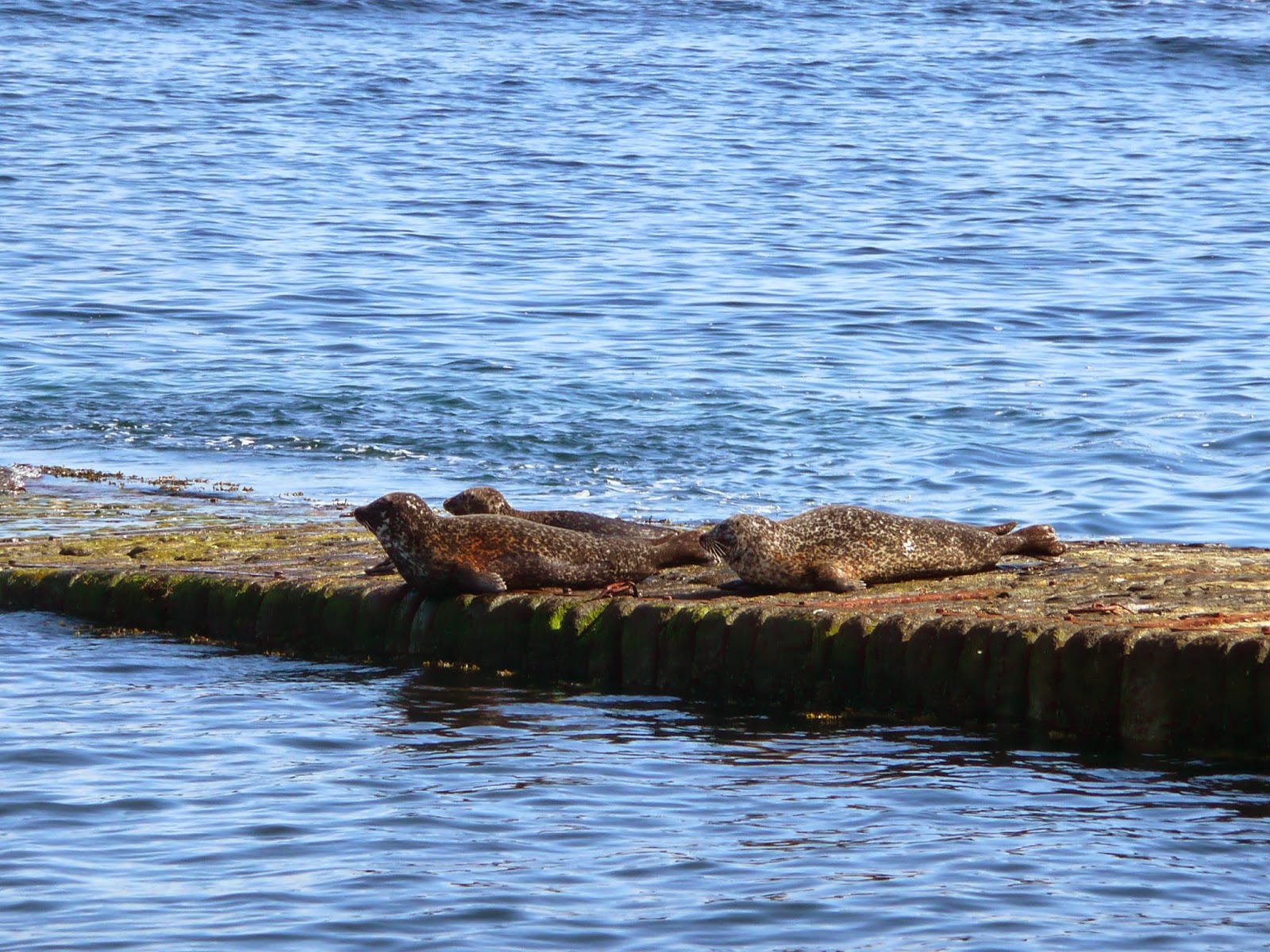
Seals at Eshaness!